Saturday, March 28, 2020

In Space, Everyone Can Hear You


I like a good deck building game, but they do tend to get a bit repetitive after a while, with different themes grafted on to what is essentially the same game. Most games of this type use the familiar "buy cards, use those cards to buy better cards" formula, and attempts to innovate usually involve adding additional currencies, such as with the Legendary series or Star Realms, where players need to balance the ability to buy better cards with the ability to combat villains (or other players).

Clank! In! Space! goes in a different direction entirely. The deck building mechanics are the same as with any deck building game, but this game adds a board and an additional currency in the form of  movement, with players moving their pawns around the board in a press-your-luck style treasure hunt similar to games like DungeonQuest, where players can go for safer, lower-value treasure or risk it all for the big score.

On top of that, there's one more thing to keep track of: noise. The premise of the game is that players are essentially burglars sneaking around a giant space ship, and certain card plays will produce noise in the form of clank tokens. At various points during the game the clank tokens are drawn randomly from a bag, and if yours are drawn they are added to a damage track. Ten or more damage knocks you out of the game, so in addition to everything else you need to take opportunities to heal damage so you can stay in the game.

A few simple additions to the standard deck building game formula makes for a more interesting game overall, but also provides a wider variety of game effects for the cards. Buying cards isn't just a matter of "does it generate money to buy more cards, or combat to defeat monsters," they can also generate movement effects and add or remove clank tokens.

The artwork and graphic design are top notch. The theme is a light science fiction parody, with cards referencing pop culture mainstays such as Star Wars and Star Trek, which is fun but also stops it from being really compelling. It doesn't generate a unique world of its own, but not every game needs to.

Rating: 4 (out of 5) An entertaining game that brings some much-needed innovation to a game genre that may be getting a little tired.

Gobliins 2 - Final Rating

By Ilmari

I am a bit torn about Gobliins 2. I began playing it with great expectations. The second game in the Gobliins-series showed clear improvements over its predecessor, being easier to play and fairer, while still retaining the wackiness of the first game. The more I played, the more irritated I became, when the game wouldn't just stop. I felt that the producers had tried to cram a bit too much into the game, that there was too much of a repetition of similar themes and puzzles and that the whole would have just improved from cutting away some of the material. I feel the need to balance my rating carefully in order to accommodate both of these aspects.


Giant's face says it all

Puzzles and Solvability

Puzzlewise, Gobliins 2 has quite a different feel from Gobliiins. The main reason for this is the move to a more traditional adventure game style, where the player has access to many different screens, instead of being forced to go through a series of discrete levels. Mind you, the game still consists of a linear series of areas, which could even be called levels, but at least these usually contain more than just one screen. This does get rid of the crudest problems of motivation in the first game, where the goal of one screen was not yet clear and became apparent only in light of a later screen.


I have to admit that especially with later parts of Gobliins 2, the goal was often
a bit hazy; for instance, here I had no indication I should be creating this portal.

Another big difference lies in the way the goblins are used in the puzzle solving. In the first game, the goblins had clearly distinct roles, for instance, only one of them could pick up and use items. Here, the roles of the goblins are more similar, neither of them having any particular skills the other wouldn't have. They still do interact with the environment in different manners, but these different manners seem often to be based just on the whim of the producers. They do try to justify these different actions by the different attitudes of the goblins, Winkle being more whimsical than Fingus, but this difference is not very strict - we do see, e.g. Fingus playing a trick on the cook of the castle.


Or trying to draw something on a picture

It's difficult to say whether the essentially similar skill set of the two goblins is a positive or a negative thing. On the one hand, in the first game it was usually the inventory person who had the most interesting things to do, the actions of the wizard being way too random and the actions of the strong guy too simplistic and often just pushing switches. In the second game, none of the goblins had a more important role than the other. Indeed, even more so than in the first game, the puzzles often relied on cooperation, when one of the goblin did something and the other had to do something else in the small window of time when the first one was doing it.This was at times even frustrating, especially if the action of the second goblin required precise pixel hunting and/or missing the window meant beginning a long puzzle sequence from the very beginning.

I've already spoken of the repetition that hindered my enjoyment of the later parts of the game, and this repetition can be seen especially with puzzles. Many of the puzzles seem like Rube Goldberg machines with an Escherian twist, in that a series of complex and sometimes even geometrically absurd steps (e.g.put goblin's hand here and see it come out in a completely different place) are required for some seemingly easy task, like getting a goblin on top of a shelf. The problem is that many of the steps used - like the just mentioned hand trick, or the one where a goblin is placed on something that is used to slingshot him - are introduced quite early in the game and then used over and over again.

Looking back at what I've written I might sound overtly negative in my opinion on the puzzles. Even with all their flaws, I do still prefer the idea of freer puzzle combinations in Gobliins 2 to the level-based style of Gobliiins. If only the puzzles would have been more varied and less in need of precise timing and positioning.

Score: 3.

Interface and Inventory

The producers have improved upon the first game and got rid of the ridiculous health bar that was nothing but painful. They even added hotspots, thus avoiding most of the pixel hunting (it still is a bit of a trouble in the timed sequences, where the hotspot exists for a fraction of a second).


Hotspots even tell you the name of the characters

If I do have to say something critical, the game mechanism of changing inventory objects between two goblins seems somewhat superfluous, since most of the time the two goblins have an identical inventory. And speaking of inventory, it is still very bland.

Score: 5

Story and Setting

The story of the game is less complex than in the first Gobliiins. For the most part, there's basically only one motivation for PCs: rescue Prince and get him home. The final twist of the game, with the Prince being possessed by a demon, comes out of nowhere and feels like it was made just to lengthen the game. Setting, on the other hand, is rich and colourful. Sometimes many of the elements don't make any sense - why is there a basketball player on a tree village? - but this just goes with the general silly tone of the game.


The dream sequences were especially delightful

Score: 5.

Sounds and Graphics

I am pretty sure the producers took the easy route and merely used all the same music as in the previous game - it still sounds good, but this is a bit lazy. Graphically the game is on par with its predecessor with images reflecting the wacky tone. All in all,since the game looks and sounds like the first one, a similar score is definitely in order.

Score: 6.

Environment and Atmosphere

I applauded the first game for its wealth of silly animated gags. The sequel also delivers on this front. Lot of the charm of the game is trying different variations in interacting with different objects and seeing if the outcome changes. Since the threat of death has been lifted, the players are free to tinker.

Score: 8.


 It was not at first apparent that goblins could be used like bowling pins.

No, let's think about this again! The final stages of the game lost the momentum, and all the wackiness just couldn't help with my growing irritation. Thus, I'll deduct a few points from this category - but not too much, since I still adore the beginning.

Score: 6.

Dialogue and Acting

Based on the two games I've played, Goblins-series is so heavily focused on clever animations that the producers have mostly ignored text and dialogue. The second game was perhaps a bit more literate than the first, but this isn't saying much.

The voices speaking the various lines sound more like overeager theater enthusiasts than true professionals. The actor in the role of Fingus is particularly lacking in talent, sounding like a second-rate imitation of Walt Disney voicing Mickey Mouse.

Score: 2.

(3 + 5 + 5 + 6 + 6 + 2)/0.6 = 27/0.6 = 45. If the game would have ended a lot earlier, this would have been a fine score, but since it now continued longer than was necessary and became more than a bit of a chore in its last moments, I'll deduct one more point. 44 it is then, making the second game a bit less to my liking than the first game. Will Moczarski wins this round!


CAP Distribution

100 CAPs for Ilmari
  • Blogger Award - 100 CAPs - For moving from great enthusiasm to utter boredom in the process of playing and blogging through this game for our enjoyment
38 CAPs for MorpheusKitami
  • True Companion Award - 30 CAPs - For playing along Gobliins 2 almost to the end and proving ample commentary
  • The Cult of Teeth Award - 5 CAPs - For taking part in the teeth appreciation comments
  • Colonel Mustard - 3 CAPs - For research on the linguistics of mayonnaise
15 CAPs for Demon Throne
  • Teeth Award - 15 CAPs - For the best set of teeth in the game
10 CAPs for Will Moczarski
  • Psychic Prediction Award - 10 CAPs - For guessing the exact score of Gobliins 2
9 CAPs for ShaddamIVth
  • The Cult of Teeth Award - 5 CAPs - For taking part in the teeth appreciation comments
  • Where No Adventure Game Has Gone Before Award - 4 CAPs - For finding out the secret of the cosmic whereabouts of TAG headquarters
8 CAPs for MisterKerr
  • It's a Good Game Award -8 CAPs - For sharing interesting analysis and memories on Gobliins 2
5 CAPs for Mayhaym
  • The Cult of Teeth Award - 5 CAPs - For taking part in the teeth appreciation comments
3 CAPs for Agrivar 
  • Mythology 101 Award - 3 CAPs - For a creative explanation of mermaid queen's missing eyes
3 CAPs for Lisa H.
  • Cooking 101 Award - 3 CAPs - For explaining how to make mayonnaise

Considering A Master's Or PhD In Digital Media?


The Digital Media program at Georgia Tech is now accepting applications at the Master's and Ph.D. levels. 

The Digital Media graduate program at Georgia Tech is a multidisciplinary program that engages students in making with meaning in digital media through their own discipline, skills, and expertise. Students here from the humanities, engineering, technology, and the arts backgrounds all engage in collaborative, practice-based work where they learn and apply design methods and critical theory in studio courses that are focused on having a voice--or giving a voice to others--through digital media.  

They offer both a two year intensive Master's degree and a Ph.D. in Digital Media, working with leading researchers that touch on topics such as civic media, game design, smart cities, interactive installation, augmented & virtual reality, computational creativity, and STEAM-based education.

They host multiple online events to inform those interested in the program. More information and RSVP is available through our website: http://dm.lmc.gatech.edu/.  The upcoming application deadlines for Fall 2019 are Dec. 10th, 2018, for the Ph.D. program and Jan. 8th, 2019 for the Master's program. 

Students interested in visiting the campus can do so during our open house event on January 18, 2019.  RSVP here.

If you have any further questions about the program and admission process, please contact me or the Associate Director Michael Terrell directly at dgs@lmc.gatech.edu.

Friday, March 20, 2020

Sanity Slips Away!

What's going on everyone!?


Today was a pretty rough day and I actually ended up hurting my back more than ever. It really sucks and is insanely painful but it's not like I knew I was going to hurt my back today any worse than it already is.

For the #2019gameaday challenge I played a game of Elder Sign: Omens and completely succumbed to the darkness. 

As always, thank you for reading and don't forget to stop and smell the meeples!  :)

-Tim

Thursday, March 19, 2020

Favourite Games -V- Most Re-Played Games


I have been recently thinking about the games I usually say are my favourite, as in my "top 5 RPGs" or whatever, and thinking about how this list overlaps with the games that I have played again and again.

What I have noticed is the lists don't really overlap.

So, my favourite game and RPG is probably FFVII, but in actual fact, I actually haven't played this game through in maybe 15 years now. Is it really the game that I should say is the "greatest"? Is that really what I think, or am I really saying "the game I have the greatest nostalgia for is FFVII"?

I don't think it is all about nostalgia though, because I only played MGS through for the first time 5 years ago, and I honestly think that that game ranks right up there in my top list of games, and in fact, I have only played it through once.

Is this honest? Do we need to have played a game many times for it to be in our top list? When it comes to films, all the films I like the most will be films I have chosen to watch quite a number of times... but with games, maybe it isn't the case.

Perhaps this is down to the amount of time it takes to complete a game, the investment, compared to a film. But even with my favourite books, I have read them a number of times, though probably not all of them....

And then there is the really weird case of games that sucked hours and hours away from my life, but don't even appear on my tops lists. RPGs that I put way down the list but which I played every last bit of juice from them, and at the time must have really enjoyed them or got something from them.... FFVIII for example- I played that to death over a full year, or Age of Empires, or Street Fighter Alpha 3, or Fifa 97, or Altered Beast, all of these I played loads, more certainly than MGS yet MGS ranks above them for sure in my estimation.


Game 361: Planet's Edge (1992)

Note that the game's title screen does not technically exclude the possibility of returning from this point.
         
Planet's Edge
United States
New World Computing (developer and publisher)
Released 1991 for DOS, 1993 for FM Towns and PC-98
Date Started: 5 March 2020
           
Because it took me so long to get Planet's Edge up and running, I had time to do more background research first--the kind of thing that I usually save for the "Summary and Rating" entry. I learned from Wikipedia that the game grew out of a desire to merge the boardgame Star Fleet Battles with an RPG. I learned from an RPG Codex interview that the developers wanted to put "Might and Magic in space." Nowhere did the authors report a direct influence from any other game, so it was a surprise when I fired it up and found myself looking at . . . Starflight. It has the same type of base where you enter different buildings to accomplish similar tasks, the same type of ship with commands arranged by "station," the same approach to galactic exploration, the same variety of weird alien races to meet, and the same take on combat. Sure, it does some things differently, but the core of the game was clearly cribbed from Starflight. Was it so hard for the developers just to admit "we wanted our own version of Starflight"?
    
There is some confusion about a couple of elements in the header. First, the title. My policy is that a game's "official" title is the best two out of three on the manual cover, box cover, and in-game title screen. If all three conflict, I go with the in-game title screen. In the case of Planet's Edge, the box includes a subtitle (The Point of No Return) that both the manual and in-game screen lack. Second, a while back, commenter shankao made a case for the game being released in 1992 instead of the official copyright date (and MobyGames date) of 1991. His argument is based on the fact that no reviews appeared for the game until comparatively late in 1992. I didn't find any conclusive evidence, but I decided to accept shankao's argument and move the game to 1992.
                 
Judging by the animate intro, the backstory is "some guy escapes a cruiser by shooting a guard and stealing a ship."
              
Planet's Edge is set in 2045. Humanity has colonized the Moon and has seeded Earth's orbit with various space stations, satellites, and other craft. The denizens of these orbiting habitats become humanity's only survivors when the rest of the planet is sucked into a "space-time warp." The warp is the result of an electro-magnetic burst fired from an extraterrestrial craft, although it is unknown whether it was accidental or deliberate (a Chinese space station had disobeyed U.N. orders and fired missiles at the craft just before the event). Either way, Earth's gravitational influence somehow remains, keeping the Moon and satellites in orbit.
             
The Luna Base commander gives orders.
            
Commander Mason Polk of Luna Base takes charge of humanity's remnant. Without Earth's resources, the base will run out of food and life support within a few years, so time is crucial. From the crashed alien spaceship, scientists recover the device that caused the disaster. They call it the "Centauri Device" and identify eight parts that they need to reconstruct it and possibly reverse its effects: a N.I.C.T.U. (but no K.L.A.A.T.U. or B.A.R.A.D.A.), an Algocam, a K-Beam, a Harmonic Resonator, a Mass Converter, a Gravitic Compressor, Krupp Shields, and Algiebian Crystals. How they came up with these names is left a bit vague. A ship dubbed the Ulysses is commissioned to scour the galaxy for these items and otherwise try to find out why the extraterrestrial ship visited and destroyed Earth. It's a little unclear how we suddenly have the ability to travel outside our solar system, or given that we have said ability, why there's a time limit on survival at Luna Base.
           
I wonder if K-beams glitter in the dark.
         
Gameplay begins at Luna Base, where the player can visit the shipyards (build and modify ships), the warehouse (offload cargo), the crew quarters (view and clone crewmembers), the research lab (check on progress with the Centauri Device), and the launchpad (head out into the universe). The items that you can build for your ship or characters depend on the resources that you bring back from other places--resources such as organics, heavy metals, alien isotopes, and rare elements.
           
Luna Base and its various buildings.
         
The crew consists of four fixed characters. The pilot is William Robert Dean from Tulsa, Oklahoma. Osai Lin Tsakafuchi from Tokyo is the ship's physician and chief scientist. Engineering duties are handled by Nelson T. Ngatadatu of Babaishanda, New Gwelo (a fictional place, but "Gwelo" is a place name in Zimbabwe). The combat specialist (both ground and flight) is Katya A. Mershova from Muntenia, Romania. Each character occupies one of the ship's four stations, some doing double duty if anyone dies. Each character has fixed attributes in body, intelligence, agility, and luck, as well as fixed skills like "Leadership," "Light Weapons," "First Aid," and "Computers." I don't know whether these attributes or skills are capable of developing, but I don't see any sign that they are. 
             
Attributes for my engineer.
         
Each character has a personal inventory, drawn from the supplies on Luna Base or found in the galaxy. The first thing I did was give them all flak jackets and weapons.

I found the ship modification process confusing enough that I decided to save it for later and just blasted off in the default ship. Once in space, commands are organized among four "consoles": navigation, weapons, engineering, and science. For instance, to communicate with another ship, you select the "Weapons" console (counterintuitively) and then "Communicate." To heal crewmembers, you select "Science" and then "Heal Crew." There are far less than 26 commands, so I don't understand why each couldn't have its own key. However, Planet's Edge does a little better than previous games using this structure by at least allowing you to hit single keys on the submenus rather than arrowing through them. Also, a few very common commands like Navigation | Starmap and Navigation | Enter Orbit can be called from the main view with individual keys, without having to go into the stations first.
           
I couldn't make heads or tails of this screen.
           
Moving around is a combination of elements seen in Starflight and Star Control II. As you fly away from a planet, the map's scale changes to show a larger area. As you enter a star system, it changes to show a smaller area. When you've locked onto a planet, you O)rbit it, at which point you can S)can it for information or B)eam down if it's appropriate. (There's no landing craft, just a transporter.) Making things a little difficult is that the planets continually whiz around their stars, unrealistically fast, so it's tough to identify which ones you've already approached.
          
Note how the navigator turns and looks at me while waiting for my order.
       
I guess the player is kind of an invisible "fifth" crewmember. I base this on the fact that, according to his mission directives, he's expressly forbidden to beam down with the rest of the crew. Also, when you're activating the consoles in the ship, each of the crewmembers turns and looks at you, as if you're sitting in a central chair. Despite this, you don't get to name yourself or anything.

A map accompanying the game shows Earth's solar system ("Sol") at the center of a galaxy occupying coordinates from -64 to 64 on two axes. Sol is the point of convergence of eight "sectors" which grow outwards from the center like irregular pie wedges: Alnasl, Ankaq, Zaurak, Alhena, Algieba, Caroli, Izar, and Kornephoros. (Most of these are actual stars). There are a handful of systems at the fringes of the map that occupy no sector. It's not really clear at the outset of the game whether the sector designations are geographic or political. Either way, note that the names of the missing parts suggest that we'll find one part per sector.

I had a few false starts as I got used to navigation. Alpha Centauri is so close that it's easy to blow past it on your way out of the solar system. I got killed three times in a row by hostile aliens who either attacked immediately or demanded cargo I didn't have. I haven't even begun to figure out ship combat. Since you can't save in space, I kept restarting on Luna Base and having to try again.
            
Meanwhile, my crew is saying, "Oh my god! It's an alien!"
           
On the fourth try, I took things more slowly and explored the solar system before leaving it, although it appears you cannot land on any of its planets (which makes sense).
       
Mars can be scanned but not visited.
        
I then carefully made my way to Centauri. The first planet, Centauri Prime, was too inhospitable to land. The second wasn't a planet but an "alien outpost." When I scanned it for information, the computer called it the "Omegan Outpost" and said that it was a "contact point for observers who were assisting with the failed Centauri Drive experiment." I guess we know all these things because of data recovered from the crashed alien ship.
            
Orbiting Centauri Prime. It's a nice looking planet, but we can't do anything there. I was hoping we'd meet Londo.
        
The four expendable crewmembers beamed down and were immediately attacked by robots firing laser guns. Combat in the game is turn-based and like nothing that New World has developed before. It is perhaps most like Ultima VI, occurring within the main exploration window and using a targeting cursor to attack particular enemies. In fact, once combat was over, I found that regular exploration was also a lot like Ultima VI. As the leader moves, the other characters kind of organize themselves around him or her. You can switch between lead characters with the number keys (although there's no "solo mode") and do other common things like L)ook, T)alk to NPCs, and do a variety of things with inventory items. You can't manipulate the environment to the same extent as Ultima VI, and (annoyingly) you can't move on the diagonal, but nonetheless, by including this level of ground exploration and combat, New World has definitely gone a step beyond Starflight and Star Control II, even if the rest of the game seems similar.
          
Combat with robots in the outpost.
              
A door led from the surface of the planet to the interior of the "welcome station," where a friendly message invited us to browse various newscasts. As we moved from room to room, we faced several more combats, and I had to use medpacks (which we found strewn around the area) several times. We also found some better armor than we were wearing (kevlar) and some extra weapons.
           
A character inventory.
         
We ran into an android who somewhat explained the situation: the station had been attacked by unknown aggressors who stole "various tactical data about the sectors." Another android offered that the disappearance of Earth was "a tragic accident" and he encouraged us to continue our quest to find the various pieces of the Centauri Device. He specifically recommended going to Algieba Sector since "there's a part that is named after one of that sector's stars, after all."
             
But . . . Earth scientists named that part! They don't know where it really comes from!
            
Beneath a plaque labeled "Sector Izar," we saw an image of a spacecraft that looks a lot like the extraterrestrial ship that visited Earth. A recorded message was saying that "something is malfunctioning with the drive" and "the experiment may have been sabotaged." The overwhelming suggestion is that Earth's disappearance was an accident, but we still don't know what the aliens were trying to accomplish.

There were a couple of alien newscasts to watch. One suggested some kind of war developing in Sector Caroli. Another reported on a "white hole"--a kind of space volcano--forming in Sector Zaurak. Unforutnately, they were just text; they didn't show anything, so we couldn't see what type of alien they were talking about.
    
I was happy to find that you can save while on "away missions" and that you can turn off the relentless soundtrack with ALT-M. The rest of the sound effects are okay, except that when you view inventory, there's an annoying and unnecessary "ding" as you move from one inventory item to another. Scrolling through a lot of them sounds like you're demanding a bride and groom to kiss. On the positive side, every item seems to have a unique description, which I always think is cool.
            
I confess I don't understand this, though. Wouldn't the adjustment have to be on every cartridge?
        
In the final room we explored, an android gave us a key that would unlock the various "android heads" strewn around the base. There were eight heads, each offering information on one or more of the galaxy's eight sectors. Some of them were explicit about the technology and military level of these sectors, I guess suggesting a rough order of exploration. From lowest to highest, these are:
               
  • Sector Algieba, where the Algiebian Empire has a low level of technology. This is the second explicit suggestion to go there first.
  • Sector Zaurak, ruled by the "Rana Collective," which controls the resources and means of production and thus has kept development at a minimum.
  • Sector Kornephoros, settled by refugees fleeing oppressive governments in Sectors Izar and Ankaq. Their technology is mostly good, but inconsistent because it is based on scavenging.
  • Sector Caroli. The android says that at the end of something called the Grand Survey, Sector Caroli was reserved for "recreation and housing for lower tech societies." There, I'll find Oortizam Labs and the Life Gallery. The only native species is the Eldarin.
  • Sector Alhena has no government. Two races called the Evian and the Scroe are in a war for its resources, while a race called the Dhoven tries to negotiate. It is a mix of mid- and high-tech ships and weapons.
  • Sector Ankaq, ruled by a planet called Shadowside, has a high level of technology.
          
The android head's rundown on Ankaq.
        
  • Sector Izar is where Centauri and the station itself are located. The android warns against penetrating further into the sector because the OMEGA (unsure whether this is the race or the name of an organization) is capable of easily destroying everyone but the Ominar.
  • Sector Alnasl, ruled by the Ominar. Lately, they have been reporting bouts of insanity and mass violence, and other races are advised to keep away. "These developments," the head noted, "may well be connected to the disaster of the Sol Experiment."
            
If this really is an exploration order, it's too bad that the developers included it instead of encouraging the more open-exploration approach of both Starflight and Star Control II, not to mention previous New World games. Thus, I decided to defy it by heading direclty for Alnasl, one of the farthest stars in Sector Alnasl. I made it there with no problem, but when I arrived, a scaled alien told me that I was in violation of some "space conducts mandate" and refused to allow me to contact the single space station orbiting the star. I never figured out how this resolved because I had to take a break to reconcile my bank statement with Quicken, and Quicken decided it needed to update and took over my screen with its request for administrative rights, and whatever I did to make my DOSBox sessions survive such screen changes was undone when I restored the default configuration to play Planet's Edge. (In its default configuration, DOSBox always crashes for me any time anything causes a major screen change, including unplugging or plugging in an extra monitor, opening or clsoing the laptop, and getting a demand for administrative privileges.) Thus, when I reloaded, I was back on the Centauri outpost. I guess this is a good place to end for now.
        
If I'm "irrelevant," why don't you let me land?
         
So far, it's a decent game that evokes the best of Starflight and Star Control II, although I suspect the alien interactions are going to be less interesting and I worry that the blatantly suggeted exploration order will be essentially required. I also think it's too bad that New World, which has a lot of experience in more traditional RPGs, didn't bring more of their mechanics to character development and space combat. But it's early. We'll see how it goes.

*****

Time so far: 3 hours

DE: Tips And Tricks On Movement

Archon School is the best School.

I'm going to be traveling on business soon so I want to get this one out to you guys ASAP.  This is a quick article on some tips and tricks when it comes to vehicle-heavy play.  As you can see in a lot of my lists, it has a lot to do with vehicles.  However, in order for DE players to get the most out of their vehicles and the units inside them, you have to be very careful in how you play them.

Dark Eldar vehicles are powerful because they have Fly and great movement, however, they are fragile and if you use them incorrectly, they will die like bitches and so will your dudes.  If you're going to die, you better kill a lot of shit to make your death worthwhile.

Before we begin, here are some useful terms for you to remember:

Falling Back
Units starting the Movement phase
within 1" of an enemy unit can either
remain stationary or Fall Back. If you
choose to Fall Back, the unit must end its
move more than 1" away from all enemy
units. If a unit Falls Back, it cannot
Advance (see below), or charge (pg 182)
later that turn. A unit that Falls Back
also cannot shoot later that turn unless it
can FLY.

Open-topped: Models embarked on this model can attack
in their Shooting phase. Measure the range and draw line
of sight from any point on this model. When they do so,
any restrictions or modifiers that apply to this model also
apply to its passengers; for example, the passengers cannot
shoot if this model has Fallen Back in the same turn,
cannot shoot (except with Pistols) if this model is within
1" of an enemy unit, and so on. Note that the passengers
cannot shoot if this model Falls Back, even though the
Raider itself can.

Hovering: Instead of measuring distance and ranges to and
from this model's base, measure to and from this model's
hull or base (whichever is closer).

Airborne: This model cannot charge, can only be
charged by units that can FLY , and can only attack or be
attacked in the Fight phase by units that can FLY.

Look at this threat range man.

OK, now we're ready to begin.  First, I want you to look at this picture for at least 5 minutes.  Look at the measuring tape, and then bask in the glory that is DE movement and threat range.  You get out of the vehicle by measuring from the hull (including the tip of that Shock Prow) for 3".  You move 7" with your Warriors and 8" with your Wyches.  You then have roughly 1" because you measure to the edge of your 25mm base, so you have a total movement hull to edge of base of 11".  You then have a Rapid Fire range of 12", your Blasters reach out to 18", and the rest of your shit that matters literally hits from a mile away.  Just with Rapid Fire Splinters mean you have a total threat of a little over 23" out of a transport when you measure from the base.  This is why Obsidian Rose is so worth it to me, because it extends the threat range of this bullshit even further.

Before we continue, I want to say that if you're playing with Warriors in a gunboat, you want to stay in that gunboat as long as possible.  This is because the Raider is Open-topped and you can get much more mileage out of it with better durability (T5 10W 4+/5++/6+++) than shooting at paper armor Warriors out in the open.  You have much greater threat range inside a Raider as well, since the damn thing can move 14" and you can still Rapid Fire out of it measuring from the hull.  That means you have a threat range of 26" of threat, which is a few inches greater than your Warriors walking on foot.  Yes, you heard that right, your Warriors move almost as fast as your Raiders.  Let it sink it good and long.

So why get out?  Because your Archon's aura doesn't work while you're inside the Raider.  It only works when you're outside which is why it's very worthwhile to sometimes unload all of your shit within 3" of your Raider (so they can quickly jump back in next round), get within 6" of that sweet ass bubble of the Archon, and then unload like crazy.  It's like having Flayed Skull's re-roll 1s for all of your weapons.  If you have Writ of the Living Muse while using Black Heart, here's all those crazy re-roll 1s to Wound as well.  However, if you don't need the re-rolls, just sit in the Raider for as long as possible because even if the Raider is engaged, you can still disembark from it and not count as Fallen Back for your Warriors.  You just have to get out first before your Raider Falls Back.

Get out, get buff, shoot, get scooped.

This is what I mean when I say get out, get the bonus from the Archon, and reap the whirlwind.  You're still within 3" of your Raider so you can taxi back in next movement and your Archon is still in range because 6" from base to base is actually ridiculously long.  The biggest thing I want you to take away from this picture is that I angled the camera downwards deliberately here.  Your Warriors can fire from beneath your Raider because Line of Sight is a real thing (model's point of view).  Sure, they can probably only see something in front of them, but LoS is one of those things I will bring up time and time again with Dark Eldar.  LoS really matters for them because denying damage while doing damage is the key hallmark of the faction.

Another subtle tip from this example is that the Archon has 2 units in front of him before he can be shot at if your opponent doesn't have any flyers of their own.  Be very wary when there are flyers on the map because they can zoom across the battlefield and eat you alive if you're not careful.  Those damn Hemlocks of mine have claimed so many careless generals' lives.

Weapon ranges are important.

There is a lot going on in this picture so I'm going to try to explain piecemeal.  The first thing I want you guys to look at is the range and coherency of the models.  Note that all my units in the front drawing red are in Rapid Fire of that unit of Wraithguard while the most valuable damage weapons, the Blasters, are in the back marked yellow.  The reason why I chose to show this off is that when you pull models, you can pull the extra rifles from the front to possibly deny a charge, and to preserve your longer ranged weapons whenever possible.  As a shooty army, you should preserve as much damage whenever you can, however you can.

The second thing I want to show here is the placement of the Raider in front of the Wraithguard.  Yes, I know they're WG and they shoot like crazy, but pretend they aren't for a second and I'm just using them as models.  The Raider is long, a little over 7" and acts as a perfect defensive obstacle for units that want to charge your paper armor duders in the back.  By putting a Raider in front of them, you form an artificial wall for your opponents to go around.  Therefore, you prolong the charge distance of your enemies and keep your Warriors alive another round (possibly).  Sometimes, this means you have to make sacrifices.  For Dark Eldar, I strongly encourage you to employ such tactics because, for us, it's any means to the end.  It's both fluffy and is perfectly applicable in-game.

Here's where Fly comes in handy.  If you have units inside the Raider, once you Fall Back with the Raider, they cannot shoot.  What you do here instead is:  Disembark your Warriors out of the Raider first and then Fall Back with your Raider so they can both shoot.  You just need to be mindful that you're more than 1" away from the enemy when you get out.  If your Warriors are caught in the open and are now in melee, they can't Fall Back and shoot (not conventionally at least).  Try and avoid this at all costs.  Your Raider, however, has the Fly rule and can Fall Back and shoot.  This is why if they don't kill the Raider, they won't stop it from firing on them.  The same applies to our Ravagers as well.

Now you're in range, now you're not.

Next picture is just more salt to injury.  Let's pretend those WG don't auto-hit the Razorwing and therefore will murder him.  Instead, let's treat them like TH/SS Terminators or something.  They see a juicy target, or rather, multiple juicy targets to charge.  Hmm, that Raider is 9" away, and those Warriors are a little under 12 so it's not impossible.  Oh boy, here comes a flyer 1" away.  Yup, I just increased the charge distance of those Terminators to barely possible on the Raider and not possible at all on the Warriors.  It gets even sadder because if you declare the charge because you're not careful and account for the distance traveled, I can still Overwatch even if you fail.  This is the advantage of the Airborne special rule that flyers have.  Unless that unit has Fly, you should do this and make your opponent really upset.

MSU is wonderful when used correctly.

OK, this little picture shows you the value of having multiple units in a Raider.  The above there is 2 units of 5 Warriors (2x5 config) with Blasters in a single Raider.  Everything is in Rapid Fire range and the Blasters are slightly in the back (like they should be).  Red and blue symbolizes the first movement action I take, then the second, and yellow presents where the Raider goes everyone disembarks so I can scoop up blue squad next round if they're still around.  Always have an exit strategy and a follow-up plan.  Too many times I see players just do what's in the moment and not plan ahead.  This is not how Dark Eldar plays because misplays or stupidity can literally end the game for us.  You have to be methodical, cunning and smart with how you play the game.  Now that my plan is laid out, I lay into my targets with firepower.

MSU is an abbreviation for Multiple Small Units.  This has been around forever and I've played way too many years of DE, High Elves, Dark Elves and other MSU-based armies to understand the value of it.  For Dark Eldar, this has some great uses because it allows you to do shit like the above picture.

Here are some of the other benefits of having 2x5:
  • Can split up squad as and when needed
  • Same number of Blasters as 10-man units
  • Can double up on PGLs or other sergeant weapons
  • Less vulnerable to Ld
  • Can build Brigades fast, but you also fill slots quick

The biggest boon is your ability to split up:  Your opponent has to shoot one squad to death instead of 2 so he can oversaturate fire and potentially waste shots.  This is mainly because when you declare targets, you have to declare where all your shots are going and from which guns before you roll dice.  This means if you really want a squad dead, you have to commit.  Not that it takes a lot to kill off DE infantry units in the open, but being frugal on shots or some lucky 6+++ saves means that a sole Blaster dealing S8 AP-4 D6 damage is going to go around shooting you in the dick.

Likewise, if you spread wide enough, he now has 2 targets to charge instead of 1.  Look at the distance between the two units above.  He's definitely going to commit to one side if he wants a good chance, and even if he charges one squad, that's still another Blaster that's free to shoot and not in Fall Back mode.

It all comes together to make your opponents' life miserable.

We're almost done guys, hang in there.  Look at this example above:  I placed the Archon within buff range of both units while placing two Raiders there to form the Great Wall of bad decisions.  They obviously cannot go around to assault my dudes because that's an impossible charge.  They can't fire on the Archon because there are multiple units in front of him.  The only logical target there is the Raiders, and if they charge into them, Raiders are wide enough (almost 3") to stop any follow-up Consolidation prize in the Warriors in the front.  The only thing they can do is Consolidate into the other Raider, in which case I'll Fly away and shoot him with my entire army next turn.

Now imagine I had about 4 more squads of Warriors in the back there by my Archons ready to go too.  That is a lot of units now ready to follow-up, amplified damage via the Archon's bubble, and ready to lay waste to the units who over-extended and are now in Rapid Fire range of a lot more guns.  This is an instance where charging the enemy is actually bait because it draws them in closer to the kill.  What looks like suicidal Raiders at first are now very worth it because you might have traded an 85-point Raider that is now fodder, with 225 points of key damage dealers.  That is a huge points swing in your favor.

Great, now you're playing like Dark Eldar, or in fact, any Eldar:  There is a reason why you think you're superior to all your enemies and have this outrageous arrogance around you.  You want to force as many decisions for your opponent as possible because the more decision trees you construct, the more paths there are to failure.  Shore this up with baits, feints, LoS, cover, outranging, and movement shenanigans, and you're one step closer to becoming a better Eldar player.

Be mindful of your opponents' most potent weapons and their range.

We're going to take a brief moment here and explore what it means to charge the right way and charge the wrong way.  This is because we have to be constantly reminded me of our opponents' weapon ranges and what that means for our more fragile units.

What I'm going to attempt to do here is to charge my Raider first so I can tie up those units so my lightly armored Wyches can get in there unhindered and do their thing without having to worry about Overwatch.  This is very important for all Dark Eldar players unless you're playing Coven; in which case you probably don't give a fuck because T6 4++ FNP 4W Grots are balanced units.

For example, the Wraithguard up there all have 8" D-Scythes.  They will eat me alive if I charge in there while I'm in range of all their weapons.  Likewise, picture a unit of 10-man Space Marines with Meltaguns in there as well.  This is where your knowledge of weapon ranges come into play.  You know the range of the Meltagun (12", 6" melta range) and you know where the meltas are located.  Great, now don't be within their melta range and position your Raider so that you outrange his greatest chance to hurt you.  Bolters aren't shit compared to a lucky melta shot.

This is how you do it.

Vroom, 14" of movement later, now we're talking:  Look at the position of the Raider here after I relocated.  Now, only ONE of the FIVE Wraithguard with D-Scythes have range onto my Raider.  If I'm feeling extra cheeky, I can be at 8.1" away from him so he can't OW me at all (if you're out of range, you can't declare OW).  But then again, my charge will be a little longer, so there's a risk vs. reward scenario there.  However, I want to mention that my Wyches are positioned the same way, concaved a little because now only 2 of the WG can hit the closest Wyches vs. everyone else who was conveniently placed 8.1" away.  I will pull from the back, of course, allowing my closer Wyches to get the charge and bring the rest of the girls in.  If I'm running a 2x5 squad of Wyches, the principle here still stands.  To min-max, you move the Wyches in a checkerboard formation so both squads have the same chances to get in.  Remember again; measure twice, move once.  That is the Dark Eldar way.

Alright guys, this should be good for now.  Of course, there are a bunch more tricks that I know, but I think these are the main ones that'll help get you stated.  Keep in mind that I'll be more sporadic in the next week when it comes to posting!

Monday, March 16, 2020

Improving The 2D Noise Page

One of my goals for 2019 is to improve my existing pages. Yesterday I decided to work on my old 2D noise page. We normally use Perlin/Simplex noise to make terrain heightmaps, but on that page I used Fourier transforms instead. Perlin/Simplex noise are a fast approximation of the things you can get from Fourier transforms.

The 3D renderer on that page always bothered me. It was one of my early experiments with WebGL. I had never been able to figure out exactly what I didn't like or how to fix it.

I decided to improve the renderer.

I read through the code to and realized it was written so long ago that let and const weren't even widely available! I started by updating the code style to match the code I write today. I read through the rendering code and decided to switch from raw WebGL to regl.js, which lets me experiment and iterate much more quickly.

I wanted to compare the old and new output easily, so I put them side by side on the page. I wanted to try two techniques with the new renderer:

  1. Instead of building a new 3D quad mesh on the CPU every time the data changed, I built a single 2D triangle mesh with x,y, and then read the heightmap data from a texture on the GPU. Reading textures from vertex shaders is widely supported now. This way, I only have to update the texture on each render instead of rebuilding the mesh. Unfortunately I couldn't figure out why it wasn't interpolating pixels values; I had to put in my own interpolation.
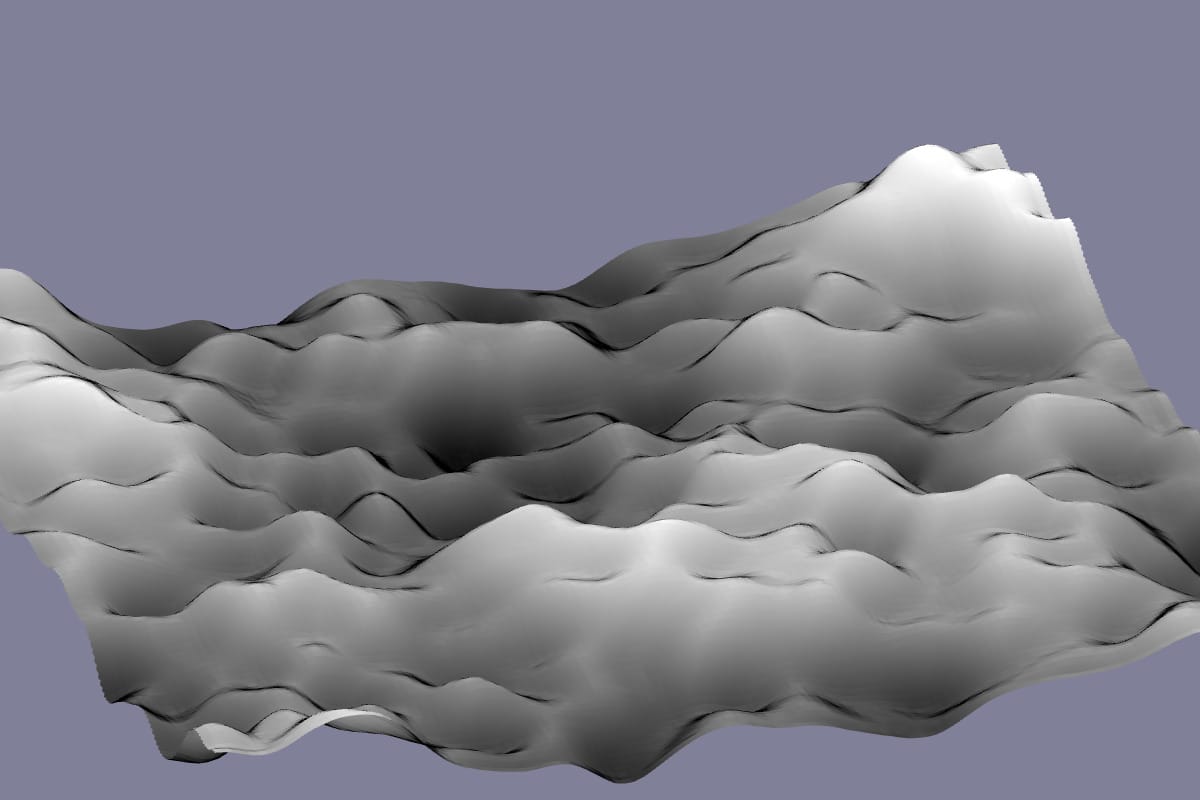
  2. Instead of calculating normals and lighting on the CPU every frame, I calculated them in the fragment shader on the GPU. But I didn't want to use a standard lighting system; I wanted to apply outlines instead. I had learned how to do this in mapgen4 and wanted to try an even simpler approach here. This worked out really well.

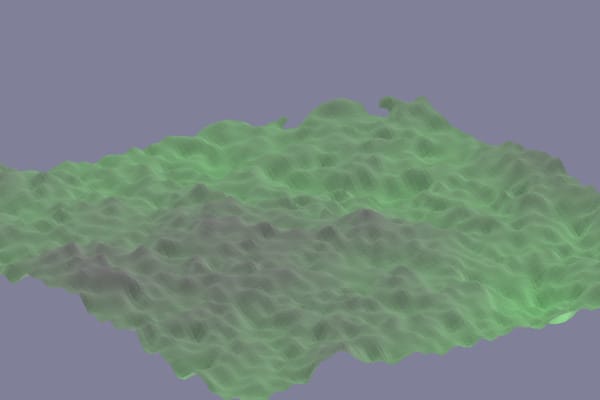
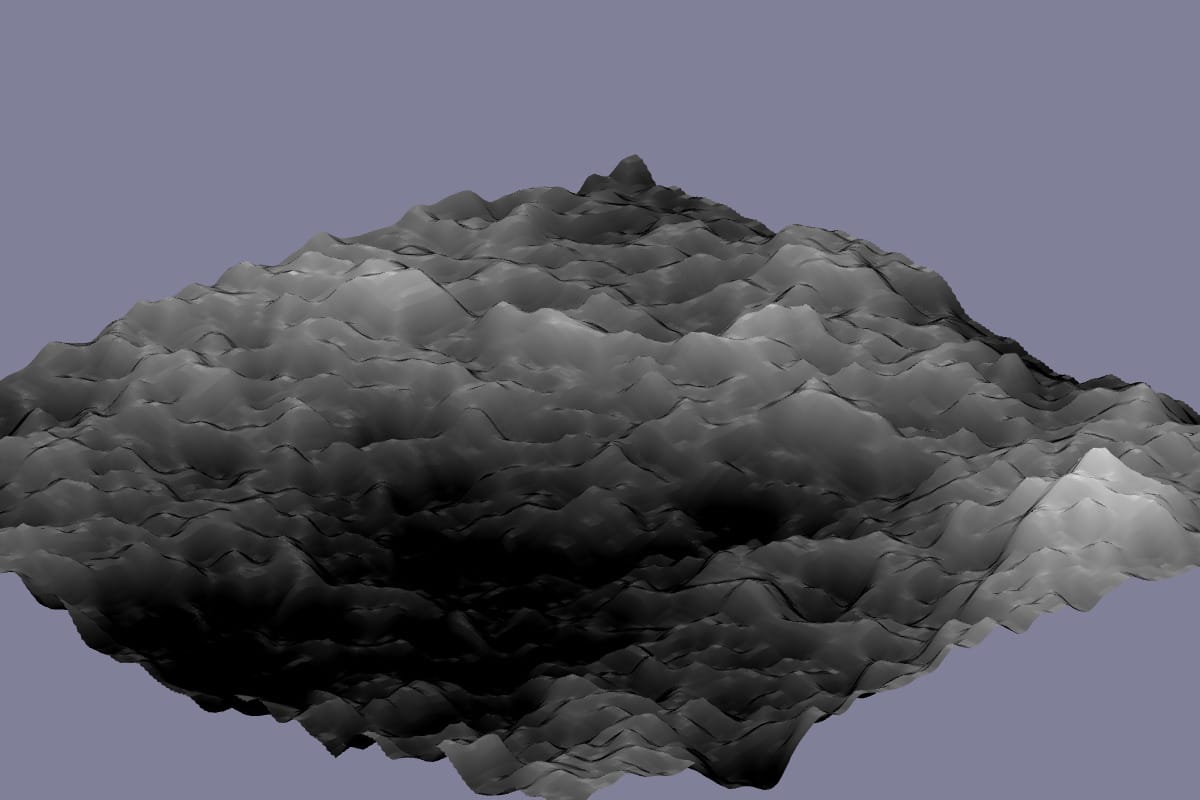
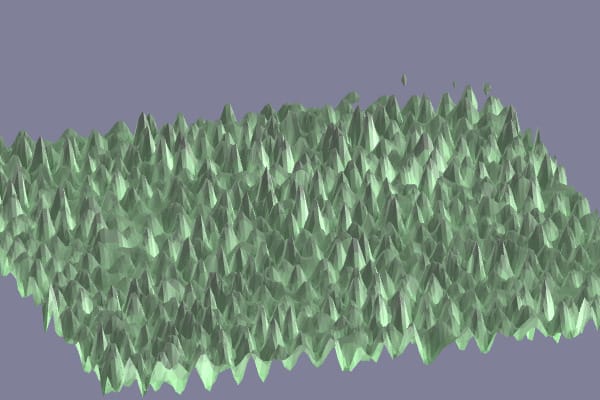
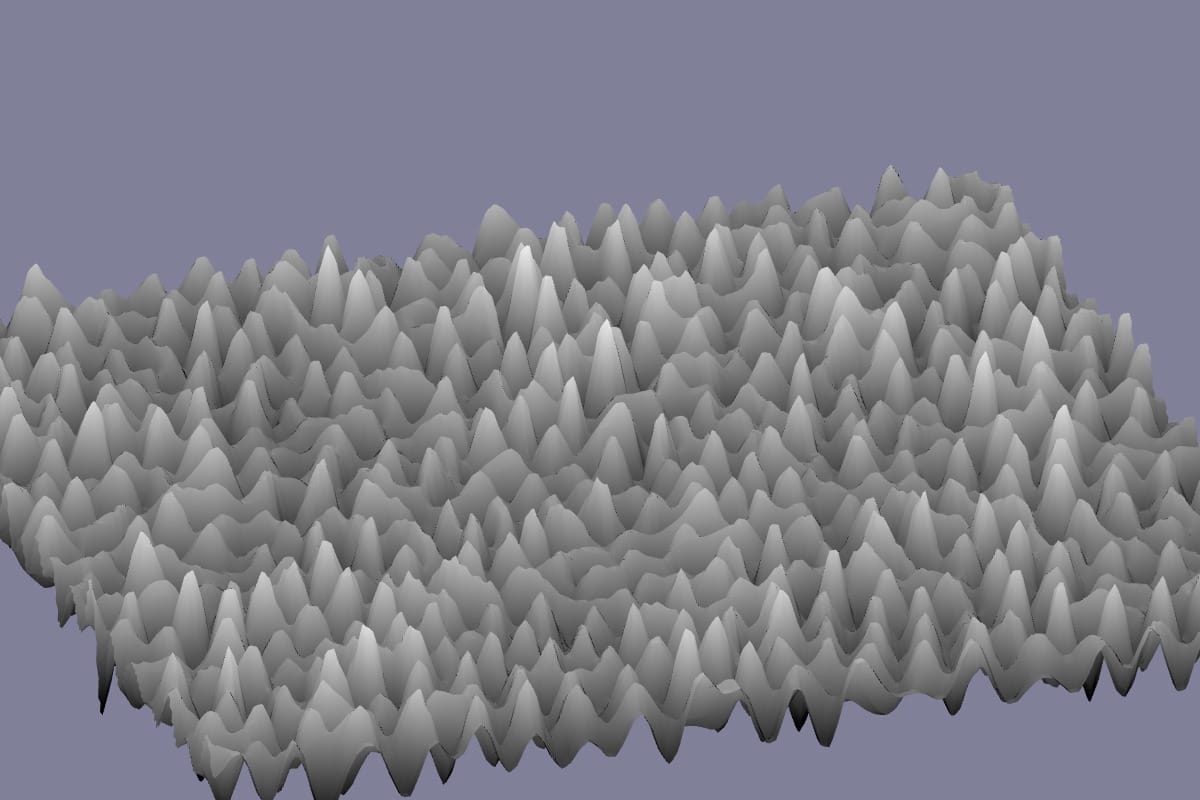
In this comparison you can see how the dark/light spots in the noise are renderered in the two renderers. With the old renderer (green) the color changes but the shapes are all mushy. With the new renderer (gray) the dark/light matches the noise, and the mountain peaks are easier to see.

2D noise values Old renderer New renderer
Landscape: old (green) and new (gray) renderer

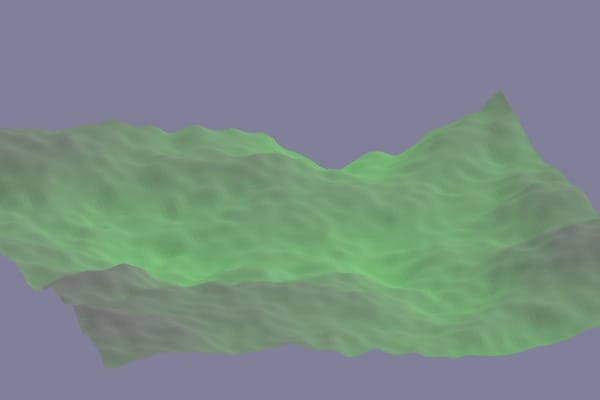
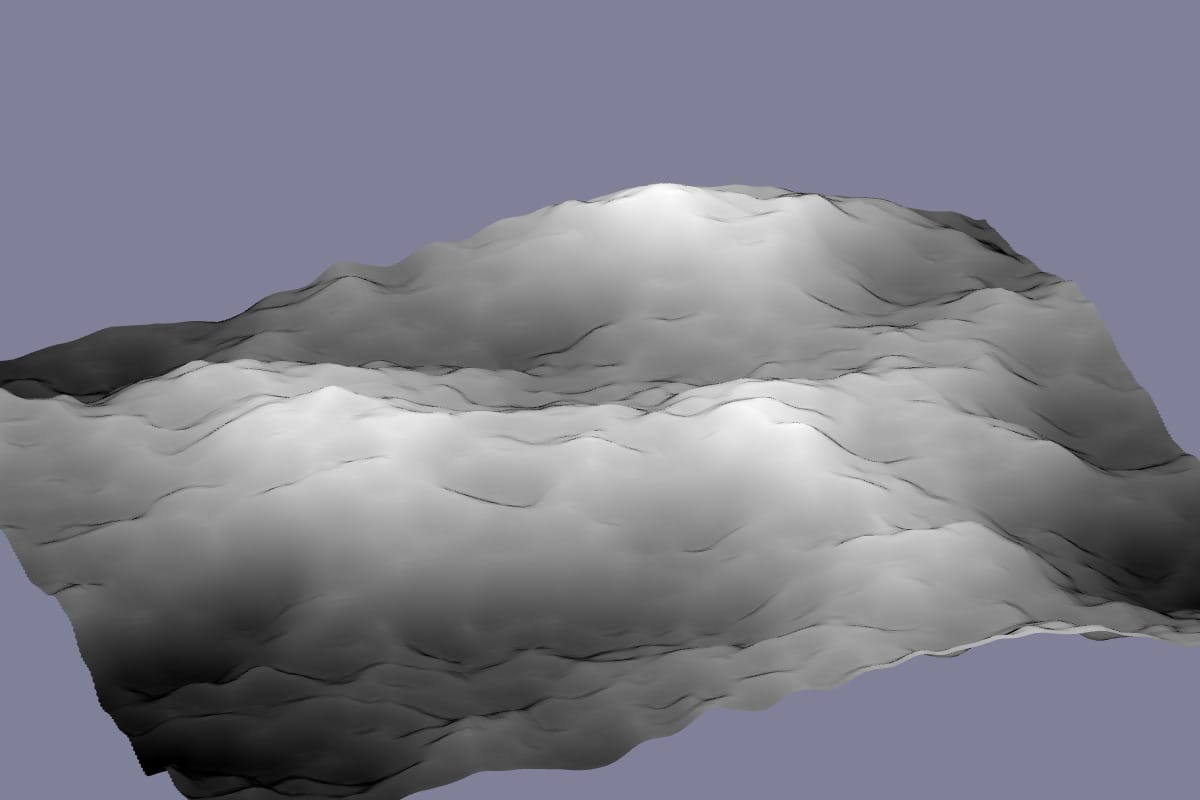
In smooth areas you can see how the outlines help show the shapes. You can also see that the old renderer flipped the elevation upside down (oops!).

2D noise values Old renderer New renderer
Smooth area: old (green) and new (gray) renderer

With blue noise (positive exponents) the new renderer looks much better:

2D noise values Old renderer New renderer
Blue noise: old (green) and new (gray) renderer

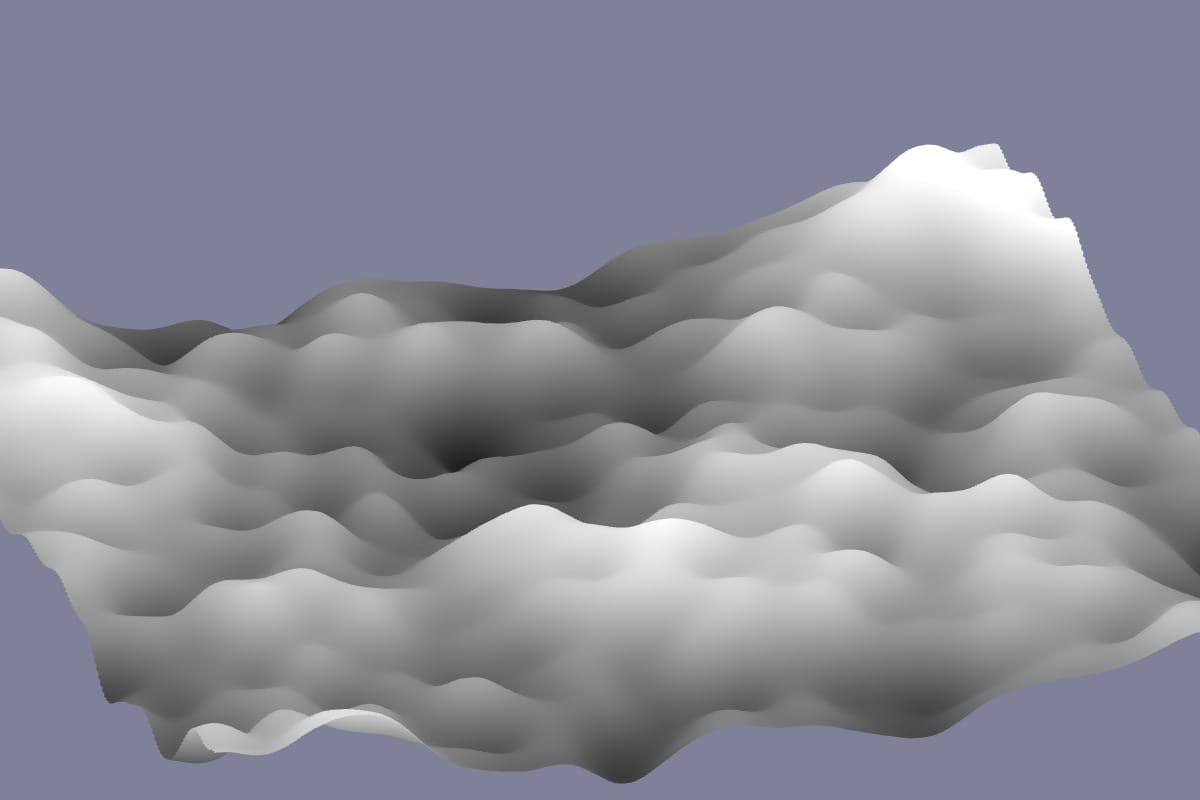
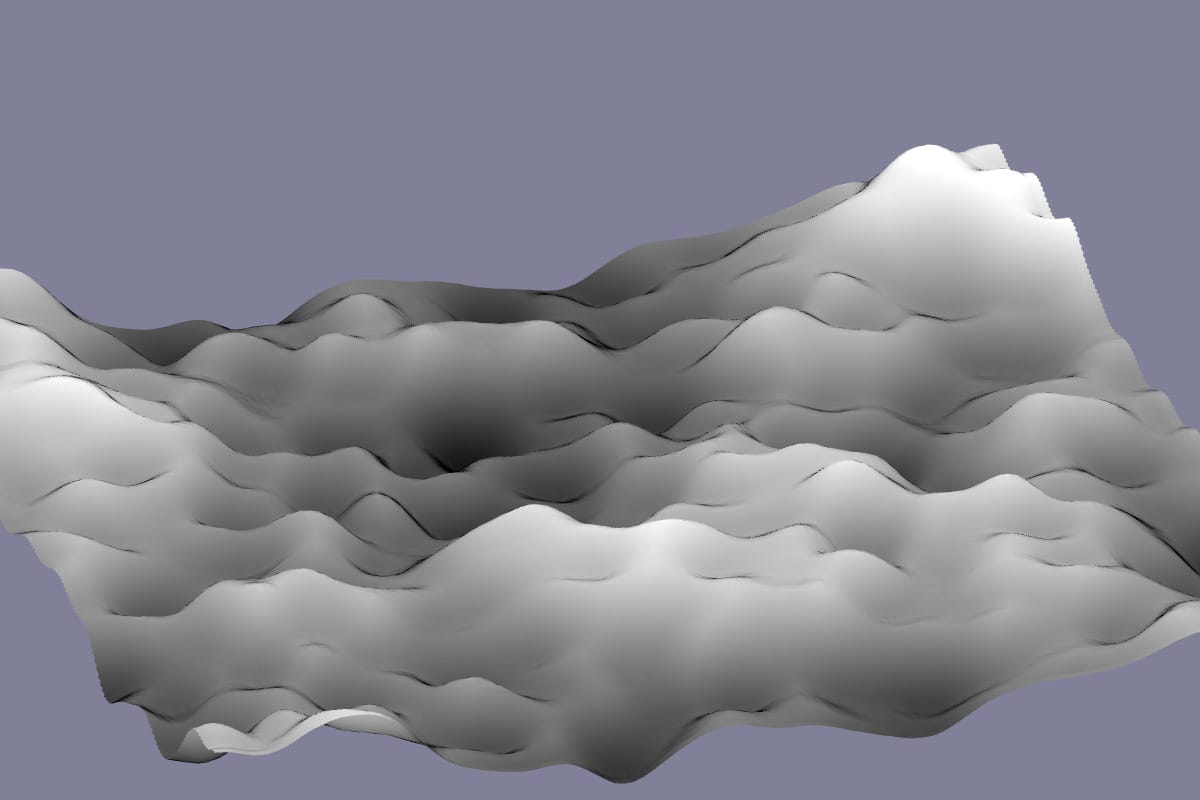
I'm really really happy with outlines! Compare:

No outlines Light outlines Medium outlines
Without and with outlines

The outlines are one line of code:

void main() {   float light = 0.1 + z - fwidth(z) * u_outline;   gl_FragColor = vec4(light, light, light, 1); } 

I darken the color based on fwidth(z). The GL extension OES_standard_derivatives calculates how much an expression changes from the current pixel(fragment) to adjacent pixels. When z changes a lot, that usually means it's changing from one mountain peak to another, so I darken the output color.

There are still more things I'd like to improve on this page, but the renderer was the thing that bothered me the most, and I'm now happy with it. The other changes will wait until another day.